Open-Ended vs Close-Ended Survey Questions: When to Use Each
Learn the difference between open-ended and close-ended survey questions, when to use each type, and how to combine qualitative and quantitative questions in customer surveys.
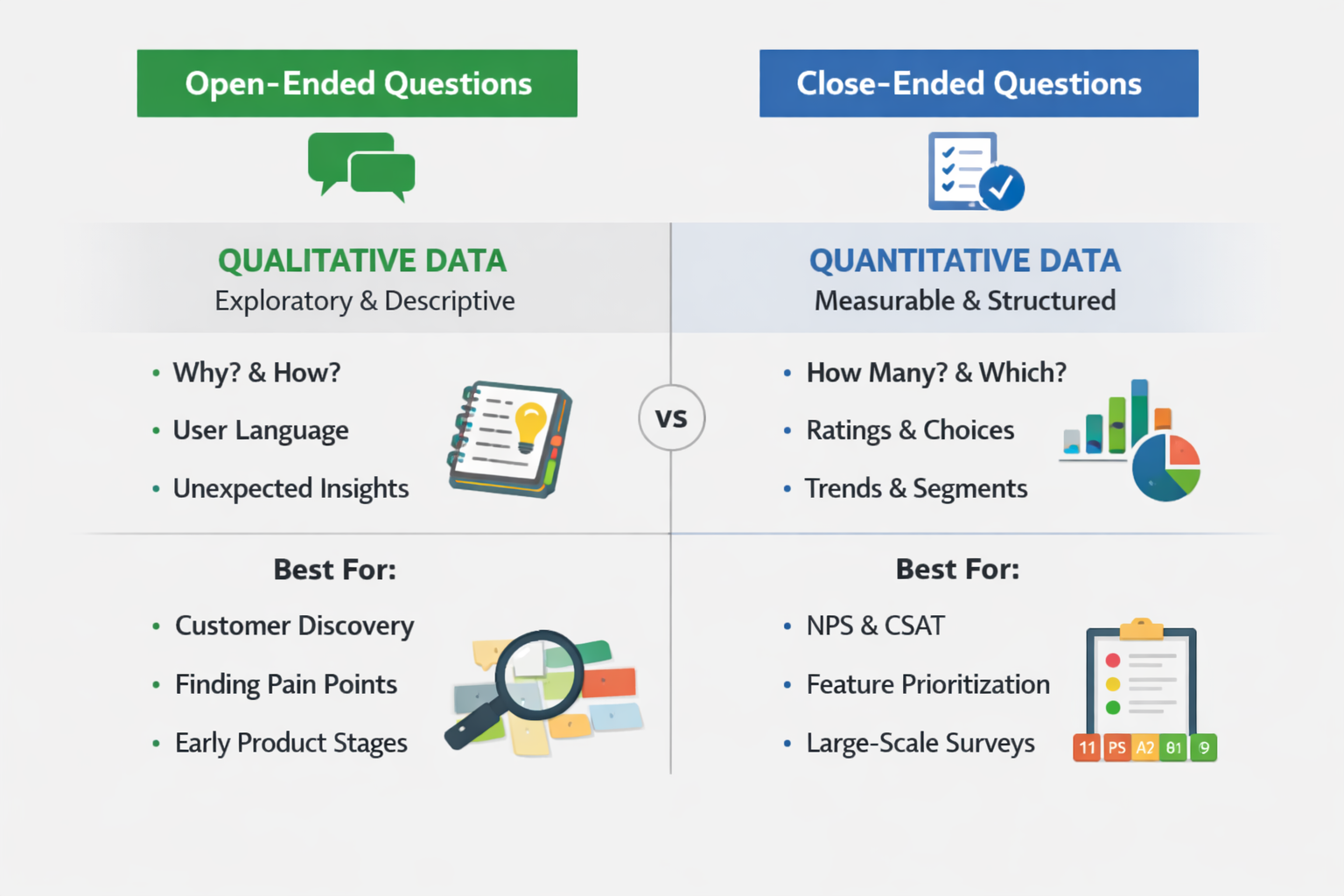
Choosing between open-ended and close-ended survey questions (two of the most common survey question types) is one of the most misunderstood decisions in customer research. Many teams default to one type based on habit, tooling, or reporting preferences, without stopping to ask a more important question: what decision is this data supposed to support?
Open-ended and close-ended questions are not interchangeable formats. They serve different purposes, produce different kinds of insights, and fail in different ways when misused. Understanding when to use each and how to combine them is critical for designing surveys that lead to real product decisions instead of ambiguous data.
The Core Difference Between Open-Ended and Close-Ended Questions
Close-ended questions are a quantitative survey question type designed to measure predefined outcomes. They constrain possible answers into predefined options: scales, ratings, multiple choice, or binary responses. This structure makes responses easy to aggregate, compare, and track over time.
Open-ended questions are a qualitative survey question type designed to explain user reasoning in their own words. They allow respondents to answer in their own words, without guidance or constraints. This makes them valuable for discovering motivations, language, and unexpected patterns but also harder to analyze and scale.
Neither type is inherently better. The mistake is treating them as substitutes rather than tools optimized for different stages of understanding.
When Close-Ended Questions Work Best
Close-ended questions are most effective when you already have a hypothesis and want to test or quantify it using structured or multiple-choice survey questions. They work best in situations where clarity, consistency, and comparability matter more than depth.
Typical use cases include:
- Measuring satisfaction, effort, or loyalty using standardized metrics such as NPS, CSAT, or CES
- Comparing preferences between predefined options, such as feature prioritization or pricing tiers
- Segmenting users by behavior, role, company size, or usage frequency
- Tracking changes over time in recurring surveys or benchmarks
- Validating assumptions at scale, for example confirming whether a known problem affects a majority of users
Because responses are structured, close-ended questions are easier to analyze, visualize, and communicate to stakeholders. They are especially useful when working with large samples or limited research bandwidth.
The limitation is that close-ended questions only capture what you anticipate. Anything outside your predefined answer set is excluded by design.
When Open-Ended Questions Are Necessary
Open-ended questions are essential when the goal is exploration rather than measurement, especially when using open-text survey questions to collect qualitative feedback. They help surface context, reasoning, and nuance that structured options cannot capture.
They are particularly useful in situations such as:
- Early-stage discovery, when the problem space is still unclear
- Understanding why users behave a certain way, not just what they do
- Identifying unexpected pain points, objections, or workarounds
- Capturing the user's own language for messaging, positioning, or UX copy
- Supplementing quantitative results with qualitative explanations
Open-ended questions often produce the insights that change how teams think about a problem. They are most effective with smaller samples, targeted audiences, and clearly defined analytical intent.
Their downside is cost: responses vary in quality, require interpretation, and do not scale easily. Without a plan for analysis, they can quickly become unstructured feedback that is difficult to act on.
The Most Common Mistake: Using Only One Type
Teams that rely exclusively on close-ended questions often end up with clean dashboards and unclear decisions. The data shows what is happening but fails to explain why. This leads to speculation, follow-up meetings, or additional research cycles.
Teams that overuse open-ended questions face the opposite problem. They collect rich feedback that is difficult to synthesize, prioritize, or defend in decision-making discussions. Insights remain anecdotal rather than actionable.
In practice, the strongest surveys combine both types. A structured question establishes scope or magnitude, followed by a focused open-ended prompt that explains the reasoning behind the choice. This pairing preserves analytical clarity while adding qualitative depth.
How to Choose the Right Question Type in Practice
The right question format depends less on the survey itself and more on the underlying research goal. Before writing any question, it helps to articulate what decision the answer should enable.
Consider whether you are trying to explore or measure, whether the audience is large or small, and how much time you realistically have for analysis. Early-stage discovery and ambiguous problem spaces favor open-ended input. Mature products, recurring metrics, and hypothesis validation favor close-ended structure.
In some cases, the best decision is to remove the question entirely. If a response will not influence an action, collecting it only adds noise and respondent fatigue.
How Question Types Affect the Overall Survey
The balance between open-ended and close-ended questions directly affects survey length, completion rates, and data quality. Too many open-ended prompts increase cognitive load and abandonment. Too many close-ended questions can feel repetitive and disengaging.
Question type also shapes downstream workflows, from analysis effort to stakeholder communication. This makes question design a strategic choice rather than a formatting detail.
What to Remember
Choosing between open-ended and close-ended questions is a strategic decision, not a stylistic one. Each format supports different research goals and introduces different trade-offs.
- Close-ended questions are best for measurement, comparison, and scale
- Open-ended questions are best for discovery, explanation, and early insight
- The most effective surveys intentionally combine both based on the decision they need to support
Designing Better Surveys End to End
This article focused on one specific aspect of survey design: how to choose between open-ended and close-ended questions. In practice, question types only work well when they are aligned with survey length, audience, and research goals.
For a complete, end-to-end framework, see the pillar guide: How to Create Effective Customer Surveys